Category Archives: Pembroke Hall Series

Alternatives

Alternative options seem to be the theme recently. Yesterday my wife and I were talking about the Deadline project, and even though she hadn’t yet seen any of it, I’ve discussed some parts of it with her. So she was telling me an idea she had for the way the book should end. It wasn’t what I had in mind, but it did put the thought in my head that maybe I should write two endings to the book to see how they fit (hey, I recently saw where the DVD of 28 Days Later has not one, not two, but three alternate endings on it – guess the director couldn’t make up his mind how to end the tale).

Lest you think I’m blindly following what my wife says because she’s my wife – she has great editorial instincts. It’s my contention that she could have been a brilliant book buyer and editor. But she’s told me she would have hated that kind of work.

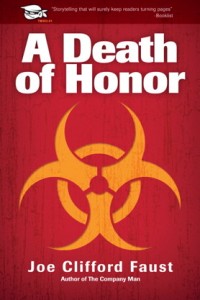
Here’s an example of her instincts at work. As I have mentioned, she reads most of my manuscripts chapter by chapter as they are written. When I was working on A Death of Honor, she made a comment to me after reading one of the early chapters: “I think Trinina is an interesting character. I can’t wait to see what you do with her.”

Indeed. What she had read was the only scene I planned for Trinina to be in. But after that comment I started thinking about Trinina and how she fit into Payne’s complacent little world, and well, it wasn’t long before she showed up at his doorstep, looking for help after having done something very, very illegal. It put a real complication in Payne’s life, moreso than what was already happening to it, and A Death of Honor was a much better novel for it.

That’s why I trust my wife’s instincts. That’s why I’m thinking about writing two sets of last chapters for Deadline.

Meantime, today I also thought of an alternate title for And/News. You’ve probably already deduced that And/News is my writer’s superstition name I’m using for this project (it was my original title for this book). I have another title I plan to market the book under, but if there are problems with that – there is a non-fiction book with the same title – then I thought I ought to be prepared. If a problem comes up, I guess I could revert to …and that’s the end of the news; but I really liked this alternative title. The only problem with it is that it doesn’t pay off until the last chapter – although it could work.

Maybe I’m worrying for naught. But it helps to be prepared. A Death of Honor was originally titled Amendment XXXI, but DelRey asked for it to be changed because, as my editor said, “it sounds too political.” I racked my brain to come up with a title and came up with a bunch of losers. I decided to come back to it and sat down with my son at the kitchen table and started playing with Play-Doh. A Death of Honor came to me about a minute later. And I had to come up with Handling It… as an “all encompassing series title” for the Science Fiction Book Club. So there is precedent.

Thus were today’s distractions. Now onto business:

Today’s Scorecard
Deadline – Chapter Five
174 pages (+6)
19,488 words (+ 672)*

And/News – Chapter Twenty
667 pages (+7)
146,922 words (+2700)**

NP – iTSP (Ben Folds Five, “Underground”)

*Word count for Deadline is approximate – the project is being written by hand.

**Today’s word count is inflated by about 1,000 words due to cut-and-pasting from the Reconciled Outline.

Another Toothbrush Postmortem

This morning I had to run down to the iBook before leaving for work to type in an addition to something I wrote last night. Just a little something to make it better.

While scraping the molars it also occurred to me that, while I referred to And/News as screwball noir, I’m not sure if that entirely fits.

I got the notion to try my hand at something like that after reading Tick Tock by Dean Koontz and being sorely disappointed. In his notes on the book, he mentioned that he was shooting for a cross between his usual gripping suspense and a screwball romantic comedy. I liked the notion of trying to put those two elements together, and told myself that I was going to try doing that sometime. Now I guess I am.

Thing is, when I started And/News, I decided to throw out some of the conventions of the screwball comedy. For those unfamiliar with the genre, here’s a short list:

1) The man is usually a stiff or formal type with his life in a certain pattern. Lost that one. Richard was at loose ends when he met K, being on the run from a failing love affair. That made him more vulnerable and less apt to do the obvious, right thing.

2) The woman is a free spirit. Kept that one.

3) The man usually gets dragged into the situation by the woman. Kept that, too… although Richard did want to dip his toe in the water. Or did he? One of the revelations from last night’s writing makes me wonder…

4) The woman is usually smarter than the man in the sense that her odd and zany ways seem to be the perfect action to take to help them survive. Tossed that one out, way out. I didn’t think that worked in Koontz’s book, and I thought that characteristic ran counter to what the genre of the thriller was all about. I thought it was more important that Richard and K not have the skills to survive, and by virtue of making it up as they go along, manage to stay one step ahead of the Pursuing Menace. After all, taking the proper action for survival dictates that you make sensible decisions that can be predicted. Right? But neither Richard nor K are capable of doing that.

In doing all of this, I have pretty much gutted the convention of the screwball romance/comedy/thriller. That’s okay, though, because I have another turn of phrase in mind that I’ve been using to describe the direction my novels are moving in.

I call it the Relationship Thriller.

Basically, the story is about the relationship between two or more people, and the thriller part is the MacGuffin* that causes a change in that relationship.

I’ve always been fascinated by the web of interrelationships between people. I once started work on a novel by making a large map of the characters involved and how their lives intertwined (that project is still on my “to be written someday” list).

Looking back at my body of work, I can see that this is where I wanted to go all along. A Death of Honor is about Payne relationship with Trinina and Nathan. The Company Man is about Andrew Birch’s relationship with the Astradyne company. There’s nothing like that I can see in the Angel’s Luck books – that’s just an outer space shoot-’em-up; and the Pembroke Hall books are satire; there are all sorts of relationships there, but that’s not what the book was ultimately about.

Maybe I was going the wrong way with those. Who knows?

However, I am headed back that way with …and that’s the end of the news; and Jamais Vu… and the mysterious UFO novel that is some years down the road.

I don’t think I invented this whole idea of the Relationship Thriller, but I’m certainly going out to stake out my claim.

NP – iTSP (Eels, “Jeannie’s Diary”)

*”(The MacGuffin is) the thing that the spies are after, but the audience doesn’t care.” – Alfred Hitchcock

Repeat Reading

An interesting morning postmortem on last night’s writing. I think it’s interesting that I’ve passed the 100k word mark and the story is showing no sign of slowing. I originally thought that it would run about 125k at most, but plans have a way of changing, I guess.

I’m wondering if, when And/News hits somewhere in my recently speculated word count, I should try as an exercise to edit it down to around 100k. I don’t know what purpose that would serve, though. So far the book seems to have everything in it that needs to be there. It’s also odd that when I sat down to write PH, I knew it would be a long project, knew that it would be about the length that it turned out.

Why the difference? Why is And/News still growing and developing? I’m not sure. Probable explanations:

1) I’m working in a new genre and haven’t developed a feel for length yet. My current projections are a fine length for a thriller.

2) With this book I am trying to commit more to character development. I was tired of my early books being criticized for thin characterization when it was there but cut for the sake of fitting into an editor’s page count. Boddekker had great characters, I think, but nobody read his story. So it’s Round Two.

3) The book is doing what it is supposed to be doing, growing organically, striding toward the length that it should be. Like Abraham Lincoln’s legs, which were long enough to reach the floor, And/News will be the length it needs to be to serve the story.

I suspect that the correct answer is all of the above.

I don’t know why I’m obsessing over word count at the moment. Likely because I’ve had “100,000 Words” pounded into my head for so long. I should stop worry about/obsessing over it and enjoy the rest of the write (I’m saving a vacation day in case I need it for my “last chapter marathon”).

I also realized something else about this project. I think And/News might be one of those books that actually improves on the second reading. This isn’t a negative thing – I think the book will be a great read the first time through.

See, I love films that become a whole different experience when you see them again. I’ve often said I envy people who get to see Casablanca for the first time. But it improves with subsequent viewings, because once you know how things turn out, you can see all of the subplots and intrigues that swirl around Rick’s Cafe and influence the final outcome. A lot of my favorite films are this way; The Sixth Sense, Unbreakable, Memento. And I bought Donnie Darko so I could try watching it again – it must get better with subsequent viewings (I liked the film overall but felt the ending goes horribly wrong somehow).

When you go back for repeated viewings with these films, you can see all of the clues that point the way to their conclusions, creating an entirely new viewing experience.

I can’t think of many books like that. Jean F. Merrill’s The Pushcart War was that way for me, but that was the difference between reading it as a 5th grader and then reading it as an adult and seeing all the wonderful satire that went over my head the first time.

I didn’t set out to do this. But it occurred to me this morning that And/News had the potential to offer… not a different, but an enhanced reading experience the second time through. And it has less to do with the thriller part of the book as it does the characters that are in it. I’m excited about the prospect.

Is this just my writer’s ego over asserting itself? I’ll have to get the book finished and published. Then you can tell me.

NP – iTunes (Garbage, “Stupid Girl”)

Repeating Yourself

I was so ticked off by this that I went out and bought a bag of Oreos. Dunked in hot black coffee and eaten when about ready to crumble, they’re heart-stoppingly good.

Had an interesting postmortem on last night’s writing session while brushing my teeth this morning. I realized that, more than anything in the world, I wanted to stay home and work on the book today. The words are all there, migrating from my brain to my hands. All I have to do is put my fingers on a keyboard and wiggle them. That’s what it feels like.

It got so bad that I actually opened up the document this morning and changed a line I wrote last night (I realized it was a punch line of sorts that didn’t live up to the setup I had given it) and typed in some notes for tonight’s go at writing.

I also thought about my inadvertent recycling of an idea from PH (the sudden revelation of an affair), and using it as a plot turn in And/News. In PH I used it as an icing-on-the-cake kind of thing (or as one of the Pembroke Hallers says, “A sweet little cupcake iced with cyanide”); it was just one more thing to go wrong for poor Boddekker (who was undergoing the usual end-of-novel torture that I put protagonists through).

In And/News, however, I do more with it. It’s a revelation about one of the characters that sends a relationship into a totally different direction, setting up a number of things for the end of the book.

I’ve debated doing this for a while and thought about doing something a little more conventional, but the thought of doing it that way seemed so… well, conventional.

The whole argument against doing it is that “I used the same device in another book;” and not just another book, but my most recent one prior to And/News (all right, I didn’t use it in the children’s book, but give a break there, huh?).

What I’m worried about is becoming John Irving. I was in college when The World According to Garp came out, and I read and loved it. So I tracked down some of his earlier books. Imagine my dismay when I started reading one… and looked at the summaries of the other three pre-Garp books… and found that they all contained the same key elements of writers, wrestlers, trained bears and quirky family members. It was like Irving rewrote the same book over and over and over again until he got it right with Garp – and then he wrote it one more time (The Hotel New Hampshire) for good measure.

(To be fair, I’ve been told that after Hotel, Irving retired his well-used props and went off in other directions. Good for him. I just don’t feel like following him there.)

I came to a couple of conclusions about the matter by the time I finished brushing my teeth. First, and the most obvious, was that in all likelihood the use of the same plot device wouldn’t even show up on the radar because nobody bought the Pembroke Hall books. Remember when I said the two books didn’t even outsell my previous worst-seller (The Essence of Evil)? It would have taken a third novel in the series to pass EoE, and even then it would have been only by about a thousand copies. The numbers were that abysmal.

But then it occurred to me – how do you determine what is an overused plot point and what isn’t? After all, love triangles figure conspicuously in five of the seven novels I’ve published (only DM and EoE lack one), and there’s one in And/News. Does that mean the device is overused?

I think it all depends on what you do with it. Is there a new approach taken with it each time, or is it predictable – like the character of the cop who is “only a month away from retirement?”* That could well be the case with the Suddenly Revealed Affair, too; it’s all in what is done with it, how it affects the plot and characters (pardon my cultural ignorance. but aren’t John Updike’s Rabbit books all about SRA’s?).

Of course, I could be overanalyzing things again. Perhaps I could have a Suddenly Revealed Affair in all of my books from here on out.

Sure. And they could all be about wrestling writers with quirky relatives and trained bears, too.

Just this one time, I promise. And then I’ll stop before I go blind.

NP – iTSP (Joe Jackson, “You and Me Against the World”)

*The sure sign of impending death or worse in many a novel and film.

Turning Up the Heat

I suppose you could call it a competition of sorts. My daughter in one room, plugging in dead matter from Ferman’s Devils into the new version of Handling It, me in the next room gearing up to work on And/News again. As I mentioned, I should work on the bonus material, but the short story should be about ready to do with one more pass through (hmmm, excuse me while I make a hard copy so I can make sure), and I’ve been making notes for the essay since I started reformatting work. I’ll need to go through the manuscript one final time when all the changes are in, so my plans are to do the essay as the last thing.

Since I was too busy for much else Saturday, part of tonight was used in catching up on my Saturday routine of answering e-mail. Didn’t get it all done, but at least some of it is out of the way. And I’m behind on bagging up books to mail out as well. Well, a few more days for those.

Then into the manuscript. I wasn’t quite where I thought I was – I thought I had left Richard and K on the road to Phoenix, but I see today that they have actually made it there, and are now in the process of arguing about their accommodations. I am seeing an interesting dynamic develop between the two of them with the addition of Vic and Ray to the party. I thought the couple from Indiana would bring my two protagonists closer together, but instead they seem to be tearing them apart.

But that’s good.

I have oft repeated, perhaps even in these pages, that the job of a novelist is to make things difficult for his protagonist. Great care must be taken to beat them up (literally and/or figuratively) and frustrate them at every possible turn. A great example of this is the last chapter of A Death of Honor. I had reached a point in the book where everything was tied up and more or less resolved, and all that remained was for Payne and Trinina to get on the ship to Australia with their son, Nathan.

After writing the final confrontation scene with the villain and putting one final twist into the plot, I stopped writing and said to myself, “Okay, time for everyone to get on the boat.”

I could feel my brow furrow. The next thing I said was, “but if they do that, it’ll be boring.”

I thought about it for a few minutes and it came to me what to do. Payne’s paper that was to get him on the ship was invalidated for some reason (hey, I finished that book in ’84 and it was published in ’87… you’ll forgive me if I can’t recall the exact details), so he made the sacrifice of putting Trinina and the boy on with the idea of staying behind. What followed next was what I affectionately call Payne’s leap – he watches the boat pull away, and he suddenly runs down the boarding platform and jumps for it. But he doesn’t quite make it, and ends up hanging outside of the boat by the rail. And then a guy with a club shows up and starts in on his hand and… well, you get the idea.

Keeping the audience hooked means constantly raising the stakes, and that’s what I did at the end of ADoH. A cinematic example of this is the work of director James Cameron, whose films are never over when you think they’re over. There’s always one more surprise waiting at the end of the reel. Most of the time this works – think Aliens and True Lies. Once in a while it backfires, as in The Abyss, which I felt had about three surprises too many.

Anyway, the routine is back and it feels good to be falling back into it – even if it was interrupted by puppy patrol.

NP – iTSP (Evita Motion Picture Soundtrack – “Rainbow Tour”)

Bonus Features

Regular readers of this space know my oft-evoked sentiment that the single most important muscle of a writer’s body is the gluteus maximus – and how it belongs in a chair in front of a keyboard.

Well, my GM is really tired tonight from sitting in a chair that is not my usual, pushing to get the last bits of formatting on HI done so my daughter can start putting in the copy edits.

And finish it I did. And I’m glad that part is through. Now I can get on with other things.

The only thing that really remains is the bonus material. That’s going to come in two-flavors. First, a short story I wrote after finishing off BD, called Miss February, which takes place in the Pembroke Hall universe by virtue of the fact that it features Love Slave Robotettes. There’s no mention of Boddekker, Honnikker in Accounting, Ferman McKluskey, or anything else Pembroke Hallish. It’s an interesting artifact that gives a little insight into how I work.

The other item will be an essay about how the story came to be divided and reunited, and if I can think of any amusing anecdotes from when I was writing it, I might include them. It’ll also explain in a little more detail how Miss February fits into the scheme of things, creative-wise.

There’s a third item I’d like to include, but I’m not even going to try because of the legal baggage that is no doubt involved. I think it would be cool to include a copy of Ian Corson’s screenplay of the books. It was getting a lot of buzz as it was being shopped around, and I think it’s a fascinating look at how something gets converted to use for film – especially since it was based on something I was extremely close to. However, I think the script is still being used as a marketing tool, and there are probably other legal considerations involved, so the world will have to simply go without it. For now.

So flirting with the essay and making sure that the short story is ready to go is next on the list. But that’s not going to be an all-consuming project like this reformatting was. I’m busy tomorrow, but Thursday I’ll likely get back to work on And/News for a while and see how much of that I can get out of the way.

NP – iTSP (Clanaad, “You’re The One”)

How Uncle Peej Did It

I can’t believe it. I was actually so brain dead at the end of the day yesterday that I forgot to blog in with my progress report.

Last night I got through what was probably the worst single part of the reformatting job. There’s a chapter in the BD half of the tale in which Boddekker reads a download of a Tiger Beat-like magazine because it has an article in it on Ferman and the Devils. The highlight was the “Girl’s Guide to the Devils,” which was inspired by P.J. O’Rourke’s National Lampoon period writings.

See, Uncle P.J. had this shtick where he would set up the concept and then put together some kind of chart to explain it all. The charts were usually comparisons of something, and were hilariously funny. So I got it in mind to do a funny chart comparing the attributes of the Devils from the viewpoint of a smitten outsider. My plan was for this to work on three levels;

1) It had to be funny.

2) It had to contribute to an understanding of each one of the Devils, and

3) It had to have some kind of dark undercurrent to it; I wanted the reader to look at it and have an “ah-ha” moment, realizing that what was supposed to be innocent fun actually told a truth about the Devils in their situation that was never openly discussed.

All of those elements are in there, although I’m not sure if they’re all evident. Talking with readers has taught me that some people pick up on stuff, some don’t… while still others pick up on things that I wasn’t sure I consciously put into the book.

The problem was in getting this chart formatted into a PDA reader friendly format. In order to do it, I had to sacrifice the possibility of an immediate “ah-ha” (since it’s no longer all laid out together), but I think what I came up with was elegant and simple. And more importantly, it worked. I got it all in, but at the cost of making me brain dead and blog-forgetty.

Maybe tonight will be more forgiving. I feel like I can really fly on getting through this project now, like the dread of reformatting that one chapter was the hurdle I needed to clear. Now I’m over it, watch me zoom.

I hope. I just ate three aspirins after getting back from an interesting ordeal. I spent all morning on a shoot and edit for a TV commercial, only to have the client nix the spot in the approval process. With no time for a reshoot. I know three cable TV reps whose day is going to be unmade as soon as they return those messages from me that wait like time bombs on their voice mail.

(Momentarily going back to that essay I did on infinite procrastination… how much better could I have made Pembroke Hall with all of these new experiences I am having? For that matter, how will I chronicle them for generations to come? Heavens, I may have to write another advertising novel…)

NP – David Gray, New Day at Midnight

Fudging Science

I am working on writing. It’s just that there’s not much to report because the work is not that exciting; going through and changing everything to the same 12 point font, reformatting all of the tables into something a PDA reader can understand and changing all the underlined material to italics (publishers want anything italicized to appear underlined in a manuscript, apparently in spite of the fact that this is the way things were done before electronic typesetting. Interestingly enough, when I originally turned the manuscript in, I had to go through and make all the italics into underlines… now I’m having to undo all of that work. If only I had known…).

So basically it’s drudge work, and there’s nothing particularly exciting or writing-worthy about it. I guess I could discuss some of the things I’ve noticed while going through the manuscript, like how I rediscovered an obscure Joe Jackson reference I put into one chapter, or how the character of Levine is one of my favorites because of the way he insults people. But that seems a little too self-indulgent, even for a blog.

So I’ve been using this space instead for other things until this project is out of the way.

I guess I could discuss the films Independence Day and Signs. I’m watching the latter with my wife (she can’t take any kind of suspense, so I have to see the film first and then talk her through it), and I am reminded of how it is still being hotly debated in the SF community as to 1) whether it’s SF or not, and 2) why it does or doesn’t suck as a film.

This is one reason I’m kind of relieved to be away from the SF community. Sometimes the fun gets sucked out of things in the name of Accurate Science or someone’s definition of what SF is or isn’t (but don’t talk about bad science in Stars Trek or Wars).

Both Signs and ID4 endured a critical drubbing in the SF community because of things like idiot plot and science that doesn’t make sense. And I’ll admit that while watching these films for the first time, some things did occur to me, such as (in the case of Signs), Why doesn’t this farm family have at least a shotgun handy? and If the aliens hate water, why are they invading Earth in general and sunny, humid Pennsylvania in particular?

But that didn’t totally kill my appreciation for either of these films. I tend to be very forgiving of things like that if there are some other things that work for me. And both of these films had it in spades. So I’m very unapologetic about liking both of them.

In the case of Independence Day, I went because I’d seen the ad during the Super Bowl of New York City blowing up, and I was in the mood for a special effects extravaganza. The movie delivered just that. It also delivered a fun and witty script, and as a writer I loved the way they took things like Area 51 mythology and the military’s penchant for $500 toilet seats and wove it all into something that works. This is a film that doesn’t take itself too seriously, as any movie is with Jeff Goldblum playing Jeff Goldblum playing a scientist. Plus, Brent Spiner’s line, “I don’t get out much,” is a look into the camera and a wink that says, we’re here to have fun, folks.

As for Signs, perhaps folks were looking for ID4 done right, or a recreation of War of the Worlds. Without falling back on the it’s not about an alien invasion so much as one man’s spiritual journey defense, I’d like to say that I would have been disappointed if Shyamalan had made a special effects extravaganza. That’s not what I expect from him. I expect quiet, deliberately paced thrillers where the characters actually mean something and develop and change. And he, too, delivered.

As for the lack of the alien invading fleet, and the complaint that for the most part the invasion was seen through a television set – welcome to the 21st century. How many of us are actually experiencing the liberation of Iraq by being out there in real time? Television is how we experience things now, and it was refreshing to me to see the TV as the family’s lifeline to the outside world during the invasion.

One thing Shyamalan understands is that you don’t need a large effects budget to put people on the edge of their chairs. You simply have to be able to relate your audience, and in this case the relation is “Alien invasion? Run to the television set!”

For all my carping at Stephen King’s sloppiness as a writer, one reason for his success is because of his ability to relate to his readers. Critics complain about his use of brand names, but when his hero grabs a Budweiser, sits in his La-Z-Boy, eats Doritos and watches his Sony TV before being eaten by a monster, people can relate. “Hey… I have a La-Z-Boy and a Sony, and I like Bud and Doritos… this monster could be eating me.

The Science Purist Crusaders among us should realize that when average people sit down with a tub of popcorn to watch a movie, they don’t care about whether or not there is sound in the vacuum of space. They want a good time at the movies. If the Crusaders can’t suspend their disbelief for a couple of hours it’s not my problem (and ironically, these are the same folks who can suspend their disbelief to the point where they buy into the idea of a world inhabited by elves, dwarves, and hobbits… but I’m not going to go there).

I’ve made a study of this. Most SF movies fudge science to various alarming degrees, but I’ve concluded it’s a necessary sacrifice, because movies with accurate science stiff. The science in 2001 was dead on for its time. It was also a Kubrickian incomprehensible mess. 2010 was better as a movie, but nobody went to see it, even though science got a fair shake there. And one of the best true SF movies ever, Gattaca, wasn’t exactly a blockbuster – but it should have been. The science was right and it was so woven into the plot that the movie would have collapsed without it.

So there’s an element of fantasy in science that makes visual SF (that is, in TV or films) work; if you want accuracy, stick with novels (if you’re interested in this notion of fantasy leakage into SF, check out James Bow’s blog of late… he’s been busy discussing this exact thing).

Besides, if you look closely at ID4 and Signs, you’ll see an interesting pattern. It wasn’t the humans who had the bad science. It was the aliens. Both times. Maybe their home worlds had serious budget cutbacks in their educational programs.

No wonder we humble terrestrials so consistently kick alien butt at the movies.

NP – Shine.FM

Prescience or Coincidence?

NOW (2003)
Maligned Nation: France
Reason: Political Infidelity
Insult: “Cheese Eating Surrender Monkeys”
Source: Many, many angry bloggers

THEN (1997)
Maligned Nation: Norway
Reason: Not given (actually chosen by author because he is part Norwegian)
Insult: “Fish Breathed Sardine Stompers”
Source: Boddekker’s Demons, a novel by yours truly.

I just happened on this while working on the HI manuscript. This isn’t the first time that something I’ve written about happening in the future has come to pass. I know, I know, it isn’t an exact match. But it sure is weird to stumble across it after a month of more of reading maledicta about the French.

The Bee

Today I had occasion to go to one of the most thrilling and suspenseful events I have ever seen. Sporting events never did much for me, and they certainly couldn’t hold a candle to the excitement of what I saw today. I was on the edge of my seat the whole time… a real white-knuckler. And in the end, there was only one winner.

I was at a spelling bee.

Fifty-two kids from four counties participated in a regional spelling bee this afternoon to determine who would go to the national bee in Washington DC later this year. My daughter was one of them. What I didn’t expect was to find myself rooting for every one of these kids. I wanted them all to win. Every time one of them got up to wrestle with their word it was a new moment of suspense. You could tell from the looks on their faces whether or not they knew the word, and you could see the wheels turning as they tried to get clues (definition of the word, language of origin).

I’m not sure why I connected so much with watching a bunch of junior high students spelling words. It might have been the connection with my tool of trade, the English language. Or maybe it was just watching 52 kids who were the best spellers in the school. The fact that my daughter was one of them this year no doubt was an influence. All I know for sure is that I had a great time, and that I’m thinking about going again next year.

Tonight I got about halfway through the Ferman’s Devils manuscript with multi-step formatting. This consisted of:

1) Turning all special fonts and font sizes into one twelve point font. Palm Digital’s reader for PDA’s doesn’t support special fonts, and there’s a lot of them in the PH books.

2) Reformatting the video scripts to be PDA friendly. I don’t think the PDA reader supports parallel columns of text, another trick I used in PH when formatting TV commercial scripts.

3) Redoing all of the chapter headings and titles so they were consistent with the layout as Bantam did it. It looks better than the way I had it in the manuscript, all lower case and flush right.

4) Turning all of the underlined text into italics. In the old days, an author underlined text that s/he wanted to appear in italics. That convention carried through to today, or had at least was still in place in 1995 or so, when the first manuscript was turned in. This was simply making the conversion easy for the reader (which does support italics).

5) Whatever miscellaneous things I spotted that needed to be done, along with making notes for some of the bonus material to appear in the e-edition.

It’s kind of interesting going through the book at high speed like this. I’m not doing a word-for-word read – instead I’m scanning pages – and I’m so familiar with the story, it’s like the whole thing is being freshened up in my brain. I’m not the type of person to laugh at my own jokes, but I did catch myself snickering at some things that I’d forgotten writing. I tend to discount my books once they’re in print because I see the all the flaws in my wordsmithing. This is making me think that perhaps the Pembroke Hall books weren’t so bad after all.

I also surprised myself by finding a reference in Ferman’s Devils to the Mihaljevic Act. Sometime after I first moved to Ohio, a girl in Cleveland named Amy Mihaljevic was abducted and later found murdered. As far as I know, her murderer was never found. This was before it was an everyday headline like it is now, and it really haunted me. So I wrote a short story called “Going To Texas (Extradition Version)” that involved, in part, a draconian law enforcement measure called the Mihaljevic Act that was designed to protect children. It was my way of lighting a candle for poor Amy.

It turned out to be one of my rare published short stories, appearing in Amazing Science Fiction. I found out later… years later… that the story made the list of recommended stories for the Hugo award (the science fiction equivalent of the People’s Choice awards) that year. It didn’t make the final cut of final nominees, but apparently was on the reading list for the year. I’ve been thinking of posting that story in the Library section of the main site.

Spelling bees, folks. You just can’t beat the suspense…

NP – iTunes Shuffle Play (Vangelis, “Tears in the Rain”)

Follow

Get every new post delivered to your Inbox.

Join 373 other followers